
Giuseppe Penone: The Reflection of Bronze
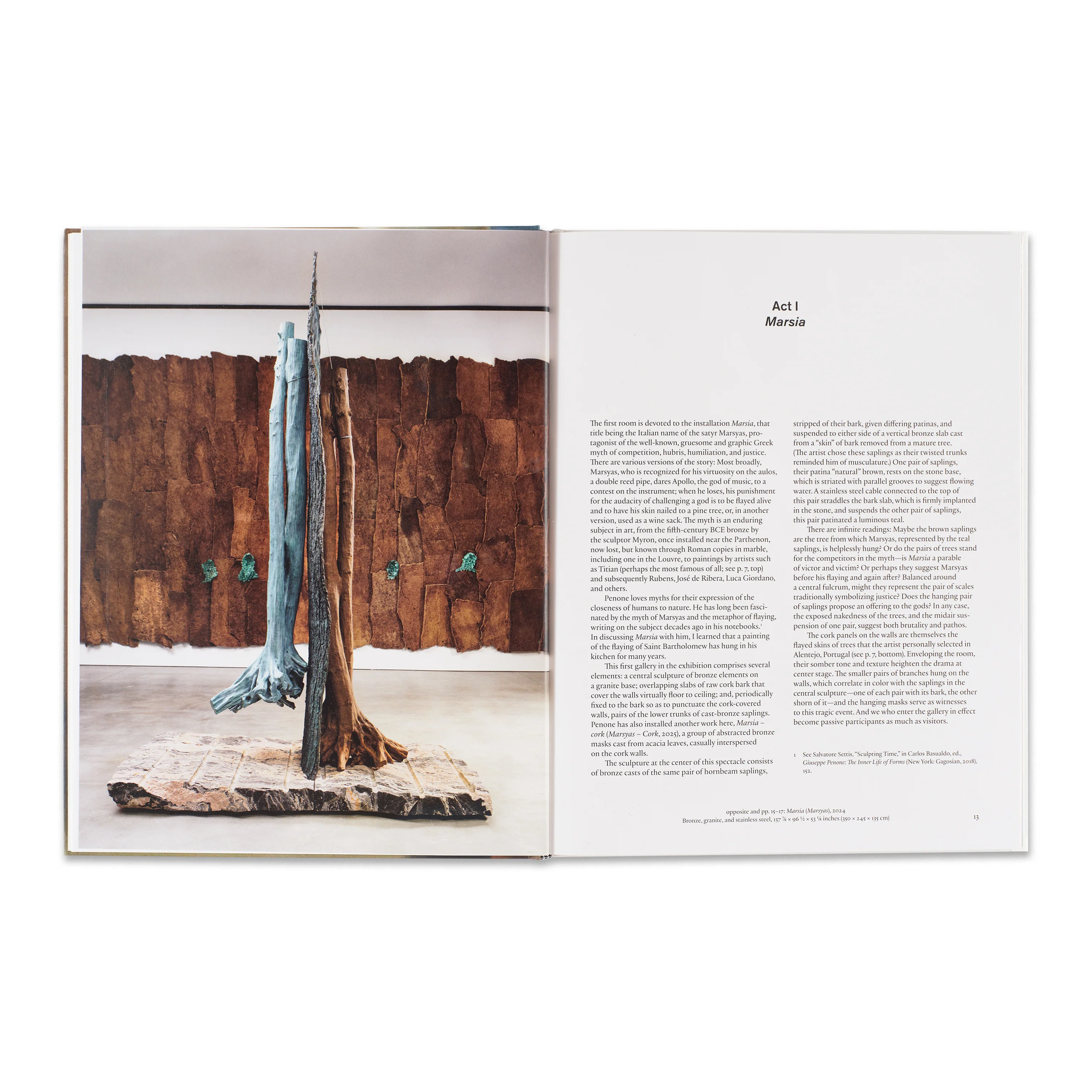
This book was published on the occasion of Giuseppe Penone: The Reflection of Bronze at Gagosian, 555 West 24th Street, New York. Featuring new bronze sculptures, this is the artist’s first exhibition with the gallery in New York and marks the debut of two major bodies of work. Curated by Adam D. Weinberg, director emeritus of the Whitney Museum of American Art, New York, it is rooted in Penone’s late-1960s exploration of trees, which led to his celebrated carved tree works and now culminates in sculptures that render the same subject permanent in metal.
The publication reproduces all the works in the exhibition in color and includes details, installation shots, and studio photography. It features an illustrated essay by Weinberg that recounts the long history of bronze as a sculptural material and considers how the exhibition’s three-room structure stages Penone’s enduring engagement with the metal. A conversation between Weinberg and Penone about the production processes and conceptual underpinnings of the new work is also included, alongside several short texts by the artist.
Original: $50.00
-65%$50.00
$17.50Product Information
Product Information
Shipping & Returns
Shipping & Returns
Description
This book was published on the occasion of Giuseppe Penone: The Reflection of Bronze at Gagosian, 555 West 24th Street, New York. Featuring new bronze sculptures, this is the artist’s first exhibition with the gallery in New York and marks the debut of two major bodies of work. Curated by Adam D. Weinberg, director emeritus of the Whitney Museum of American Art, New York, it is rooted in Penone’s late-1960s exploration of trees, which led to his celebrated carved tree works and now culminates in sculptures that render the same subject permanent in metal.
The publication reproduces all the works in the exhibition in color and includes details, installation shots, and studio photography. It features an illustrated essay by Weinberg that recounts the long history of bronze as a sculptural material and considers how the exhibition’s three-room structure stages Penone’s enduring engagement with the metal. A conversation between Weinberg and Penone about the production processes and conceptual underpinnings of the new work is also included, alongside several short texts by the artist.