
La fine di Dio
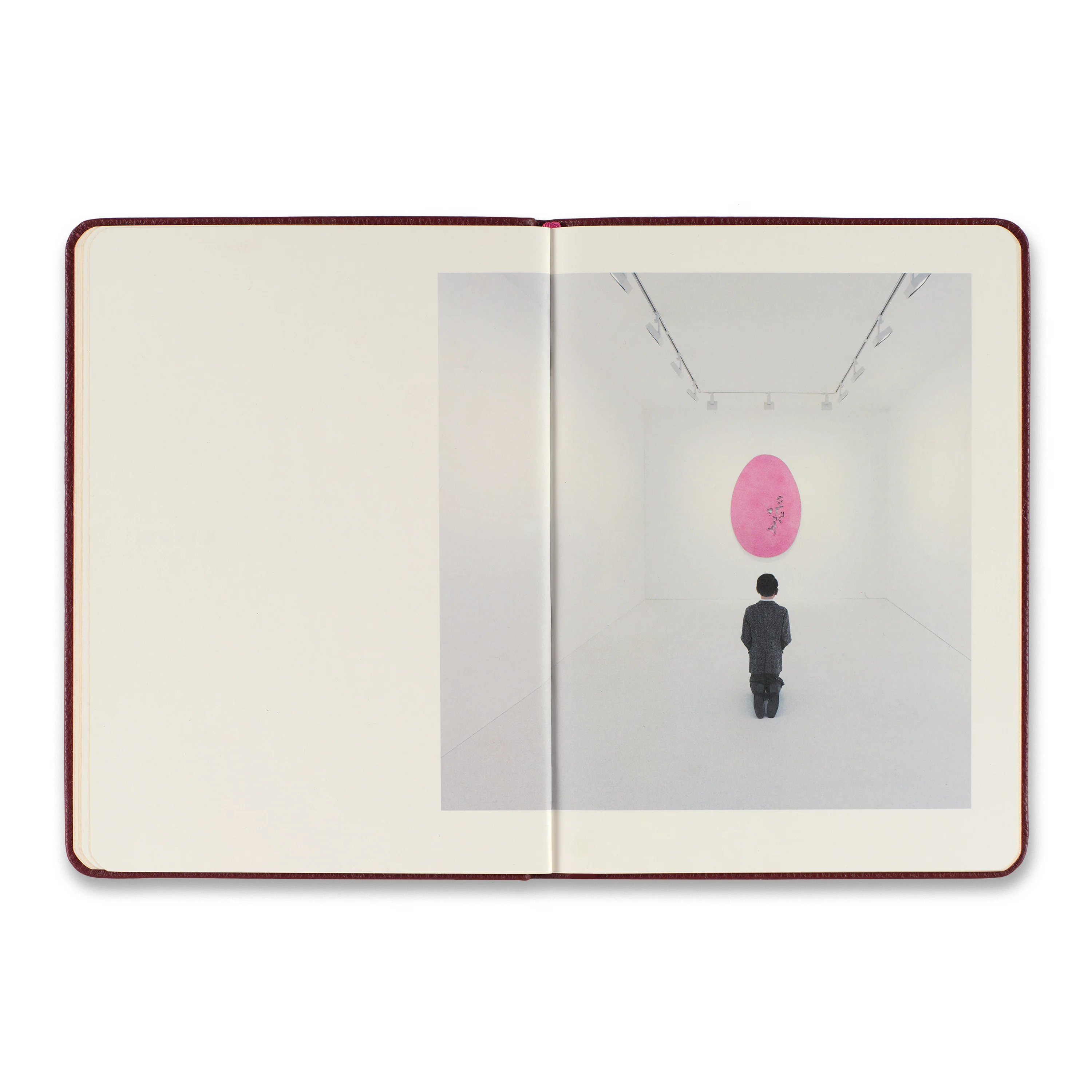
This book was published on the occasion of La fine di Dio at Gagosian, Davies Street, London. Curated by Francesco Bonami, the exhibition juxtaposed two works by two artists known for investigating the relationship between the sacred and profane—Lucio Fontana and Maurizio Cattelan—and took its title from the former’s painting Concetto spaziale, La fine di Dio (1963). In the gallery, Fontana’s climactic canvas, whose pink, egg-shaped surface has been savaged by the thrusts of a sharp knife, formed an altar before which Cattelan’s HIM (2001)—a childlike figure of Adolf Hitler—appeared to kneel in unlikely supplication.
The small-format catalogue is bound in leather and features gilded edges and a ribbon bookmark. Inside, it reproduces the two exhibited works with details and installation photography, and includes an illustrated essay by Bonami that details this unique project’s contribution to the history of iconoclasm. “Art has been,” he reflects, “and still is, one of the greatest casualties of human folly.”
Original: $80.00
-65%$80.00
$28.00Product Information
Product Information
Shipping & Returns
Shipping & Returns
Description
This book was published on the occasion of La fine di Dio at Gagosian, Davies Street, London. Curated by Francesco Bonami, the exhibition juxtaposed two works by two artists known for investigating the relationship between the sacred and profane—Lucio Fontana and Maurizio Cattelan—and took its title from the former’s painting Concetto spaziale, La fine di Dio (1963). In the gallery, Fontana’s climactic canvas, whose pink, egg-shaped surface has been savaged by the thrusts of a sharp knife, formed an altar before which Cattelan’s HIM (2001)—a childlike figure of Adolf Hitler—appeared to kneel in unlikely supplication.
The small-format catalogue is bound in leather and features gilded edges and a ribbon bookmark. Inside, it reproduces the two exhibited works with details and installation photography, and includes an illustrated essay by Bonami that details this unique project’s contribution to the history of iconoclasm. “Art has been,” he reflects, “and still is, one of the greatest casualties of human folly.”